Printing parts for local businesses
Our business service would focus on custom plastic components, trial designs and small batches that customers can reorder.
Five product ideas to test
| Candidate product | Likely customer | Why they may reorder | Validation before sale |
|---|---|---|---|
| Camera accessory mounts | AV installers / camera shops | Different brackets for repeated installations | Fit, fastening, load, temperature; no critical support |
| Cable clips & routing guides | AV / electronics installers | Multiple sites using a common cable layout | Cable diameter, retention and flame requirements |
| Sensor / electronics enclosures | Small hardware businesses | Small product runs and design revisions | Board fit, ventilation; no electrical certification claimed |
| Knobs, spacers & noncritical covers | Repair shops / maintenance teams | Replacement of unavailable plastic parts | Dimensions, wear, rights and operating conditions |
| Alignment jigs & assembly fixtures | Local workshops / manufacturers | Repeat stations and replacement tooling | Process accuracy, wear, temperature and operator review |
Product ideas to test, not confirmed purchase demand. Application basis: Formlabs manufacturing aids and end-use manufacturing applications.
Start with a sample, then a batch
We would focus on one-off prototypes and batches of 10–200 small parts. FDM avoids dedicated mould tooling and allows design changes between runs.
High-volume, simple commodity parts are not our main advantage. We compare total delivered cost and lead time, and refer larger suitable runs to conventional manufacturing partners.
Keep approved designs for reorders
With permission, store approved CAD revisions, material specifications and inspection notes. Print repeat orders from the approved version instead of holding large finished inventories.
Keep filament and common hardware in dry storage, use two suppliers for standard materials, and reserve queue capacity for agreed reorders. Parts are not interchangeable until validated.
Ask what parts are needed
Interview 15 local buyers about stockouts, current costs and lead times. Request sample dimensions rather than assuming every part can be printed.
Run five paid trials
Secure five paid trial batches. Measure print hours, rejects, finishing labour and fit before offering recurring pricing.
Check whether customers reorder
Ask for repeat orders after acceptance. Target two recurring accounts by day 90; expand only when contribution and capacity support it.
Our workshop plan
Compare actual location listings and estimated rent →
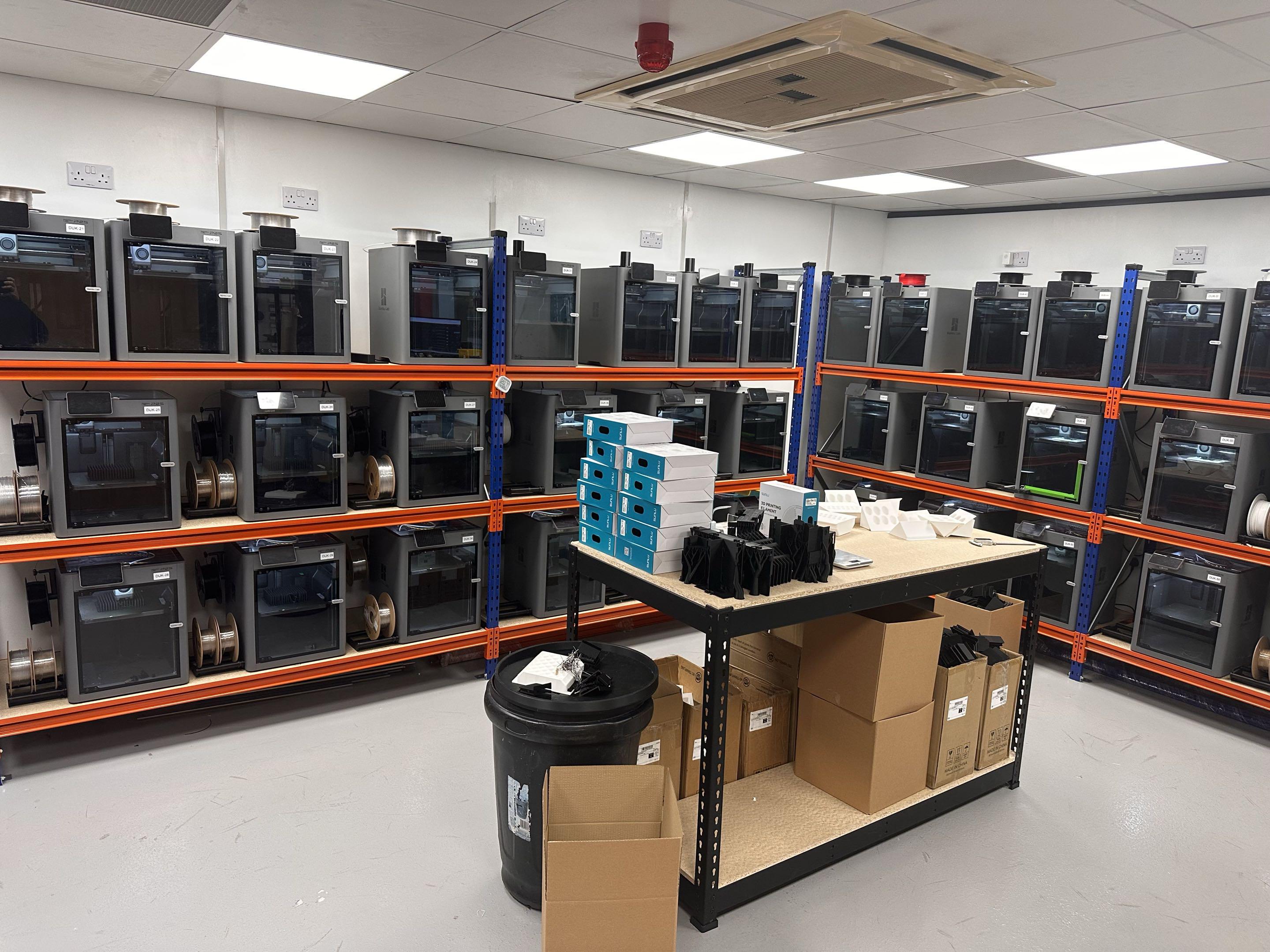
Proposed Metro Vancouver workshop
Lease a modest light-industrial unit, subject to permitted use, electrical capacity, ventilation and insurance review. We have not signed a lease. See the linked location comparison for researched properties and rent calculations.
Four enclosed FDM printers; a separate CAD/inspection bench; dry filament storage; labelled order bins; and a packing area. Production and storage stay together; pickup is by appointment.
The photo is supplied inspiration for a larger future print farm. Launch costs are allowances, not vendor quotes.
Workspace ventilation reference ↗